
Five Fire Hoses
What is getting in the way of people eating well?

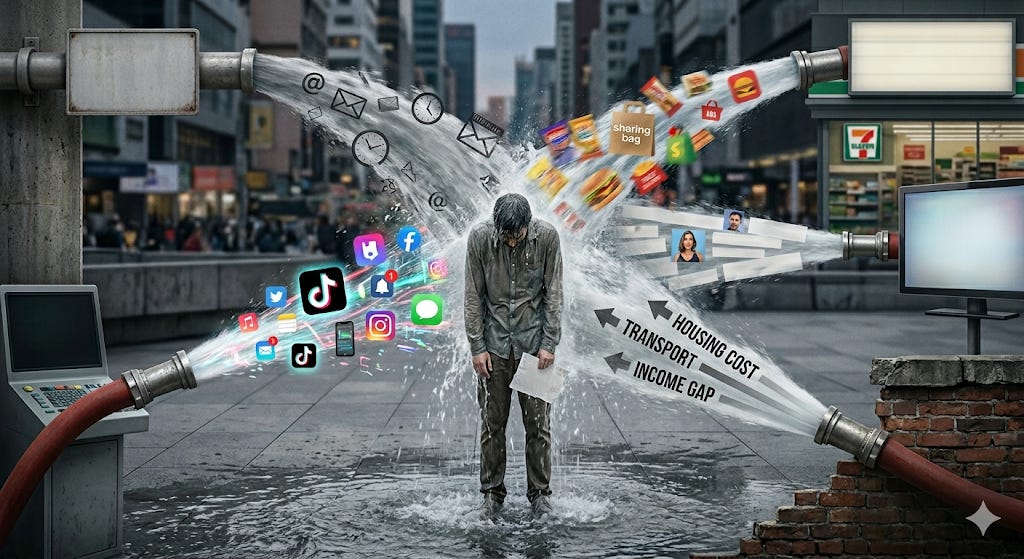
There’s a moment in almost every consultation I do where the person across from me says some version of the same sentence:
‘I know what to do, I just can’t eat well.’
They say it like a confession.
Like they’re admitting something shameful about their character.
And then they wait for me to tell them what they already know - eat more protein, prep your meals, cut down on the snacking.
But I’ve stopped hearing that sentence as a statement about food. I hear it as a statement about everything else.
I’ve been doing this for over a decade now.
And I can tell you: the person who ‘can’t eat well’ is not failing at food. They are standing under five fire hoses, all blasting at full pressure, all day, every day - and someone has told them the problem is that they’re wet.
These are five external systems.
Each of these have their own internal logic, each one independently degrades your capacity to make good food choices. And they don’t just add up, they multiply. They interact in ways that make the combined effect far worse than any one of them alone.
Most nutrition advice ignores all five.
It focuses entirely on the water on the ground - what you ate, how much, what time - and never looks up at what’s pouring onto you.
Let me show you the hoses.
Hose 1: Modern Work
Modern work doesn’t just make you tired. It depletes the specific brain structures responsible for impulse control and deliberate decision-making.
Your prefrontal cortex - the part of your brain that says ‘maybe not the biscuits’ handles both your work decisions and your food decisions, it’s essentially the same hardware and same finite resources. By the time you’ve navigated a day of emails, meetings, decisions, politics, and the low-level anxiety of never quite being on top of everything, that hardware is struggling to keep up.
The challenge for most people is that it’s running on empty at exactly the moment most food decisions happen. I can’t think of a single person I’ve worked with who is bingeing at 9am. The wheels come off at 2pm, or 4pm or 9pm, at the end of the working day when the cognitive tank is dry.
The person who eats well at breakfast and badly at dinner is the same person, but they’re just using a brain that’s in two different states of depletion.
84% of knowledge workers work overtime, and a study of UK adults last year found 91% experienced high or extreme stress in the past year. 1 in 3 of us doing desk-based jobs find it hard to eat well because of time constraints - but I would argue that it isn’t time, it’s bandwidth. The time is there, the capacity to use that time ‘for good’ has gone.
Every time our phone pings while we work, it takes an average of 23 minutes for us to refocus - 10% of our working year, lost to refocusing. Every refocus draining the resources that you’ll need later when you’re standing in the kitchen wondering what to eat.
Work is the first fire hose. And it’s running before we’ve made most of our food choices.
Hose 2: Tech and Digital Life
Your phone isn’t just a distraction at work, but it’s also the infrastructure that allows every other fire hose to reach you. We pick up our phones hundreds of times per day, and spend 6-7 hours on them. We process roughly 74GB of data per day, with less than 1% of it reaching our conscious awareness. The other 99% is noise, but our brain still has to filter this out. The mere presence of your smartphone - face down, silent and no notifications - can reduce your working memory. The brain allocates resources to not checking it, and those resources are then unavailable for other tasks.
It also acts as a vessel for the other external forces that affect our food choices - work reaches us through emails and messages, influencers are on our feed, food delivery apps are on our home screens - and the constant attention-switching keeps our prefrontal cortex in a state of permanent partial depletion where we’re never fully offline.
UK users spend 49 approximately hours per month on TikTok alone - the equivalent of a full working week. TikTok is designed where a constant-swiper could watch 1000 videos in an hour, each one with a micro-demand on your attention. Each one leaves you with less cognitive bandwidth than before.
Yet we’re still told the issue is ‘you haven’t meal prepped’
Tech is the second fire hose, as well as the pipe that connects all the others.
Hose 3: The Food Environment
If the first two hoses deplete your brain, the third one catches the depleted version of you and makes overconsumption the path of least resistance.
The food industry has spent decades engineering friction out of overconsumption and friction into healthy choices. I don’t say this as a conspiracist, merely as someone who is interested in business and can see that this is clearly the smart business choice.
The mechanics of friction are everywhere once you see them:
Sharing bags remove the pause of unwrapping. You eat 44% more crisps from a sharing bag than from individually wrapped portions.
Larger containers increase consumption by 151%.
Online food orders are 35% larger than in-person orders - because the social friction of a human watching you order is removed.
95% of purchase decisions are subconscious.
Meanwhile, healthy food costs more than twice as much per calorie as ultra-processed food, a gap that is widening considerably. The economics push in the same direction as the design, and will likely only be slowed down by indirect intervention (such as GLP-1 use).
Hose 4: The Wellness Industry
I think this is the one that is the cause of most of my professional anger.
As I’ve argued above - we’re overwhelmed, depleted and provided a food environment that nudges us towards less nutritious choices. We don’t feel good about this, and many will seek for help to know how to change their personal circumstances.
The platform we choose for our help-seeking is the most entertaining and informative one we can find - which happens to be social media.
What do we find?
Contradictory information, served at industrial scale, by people with financial incentives to keep you confused. A study identified 53 nutrition ‘super-spreaders’ - the most influential voices in the online nutrition space.
96% had financial incentives tied to their content, 59% had no nutrition qualifications at all. The top earners make up to £100,000 per month.
They’ve figured out that fear drives engagement, while balanced content generates sod-all. The algorithm rewards panic, not nuance - and so the content that reaches you isn’t designed to help you, it’s designed to engage you. The most engaging thing in nutrition is telling someone that something they eat is going to kill them.
The result is two toxic exits - and both make the problem worse.
Exit 1: The orthorexia pipeline. A study found that 49% of people who follow health accounts on Instagram showed symptoms of orthorexia - obsessive restriction and anxiety around food - compared to less than 1% of the general population. The content that’s supposed to help you eat better is making you eat worse, just in a different direction.
Exit 2: Nutrition backlash. Other people exposed to enough contradictory advice don’t search harder for the truth, they just give up. They reject all nutrition advice - including the stuff that’s actually useful. Research shows that people with the highest backlash scores significantly reduce their fruit and vegetable consumption. Learning more made them eat worse.
And here’s the cruellest twist: the person stressing about whether their spinach has oxalates is spiking their cortisol - which is probably more metabolically damaging than the oxalates ever were.The wellness industry doesn’t just fail to help. It actively manufactures the anxiety that drives the problem.
The fourth fire hose sells you an umbrella with a hole in it.
Hose 5: Everyday Life - The Structural Floor
This is the fire hose most nutrition advice pretends doesn’t exist.
Before work depletes you, before tech fragments you, before the food environment catches you, before the wellness industry confuses you - there’s the structural reality of our life. The socioeconomics of food that make ‘eating well’ a genuine challenge for so many.
The poorest 20% of UK households would need to spend nearly 50% of their disposable income to afford the government’s recommended diet. For families with children, that rises to 70%. The wealthiest fifth? 11%.
Healthy food costs over twice as much per calorie as ultra-processed food. And that gap is growing - healthy food prices are rising at nearly double the rate of UPF prices. Ultra-processed food intake increases linearly with food insecurity severity. This isn’t the sort of thing you can willpower your way out of.
I want to be honest about where I sit on this. Most of my clients have the structural basics covered - they have income, time, and kitchen access. Individual nutrition coaching is, by and large, for those with the disposable income to be able to prioritise it. My argument is that even with those advantages, the other four hoses still defeat most people’s food choices. But it would be dishonest to talk about food systems without acknowledging that for many people, this fifth hose - the structural floor - is the binding constraint. Everything I’ve described above is layered on top of an already impossible situation.
A person working two jobs, commuting 90 minutes, with two children and £50 left after rent doesn’t need a meal plan or a sodding mindfulness app. They need a different structural reality. Most nutrition advice - including the well-meaning kind - implicitly assumes a baseline of time, money, kitchen access, and cognitive bandwidth that millions of people don’t have.
Where the Hoses Meet
These aren’t five separate problems, but five systems feeding into the same bottleneck: your finite brain.
Work drains your cognitive capacity, tech fragments what’s left. The food environment catches your depleted brain with friction-free overconsumption, creating guilt that the wellness industry monetises. And everyday life sets the baseline of how much capacity you had to begin with.
But the real damage happens where they interact:
Work stress → more phone use → more targeted food ads → more impulse purchases
Cost pressure → more UPF → health anxiety → wellness content → more confusion → more stress
Tech fragmentation → worse work performance → longer hours → less recovery → worse food choices
Food guilt → seek information → encounter contradictions → more anxiety → more emotional eating
Each hose makes the others worse - The person inside the system experiences it as one thing - ‘I just can’t eat well’ - but there’s nothing ‘just’ about it. Five interlocking systems are producing that output.
Telling them to try harder is like telling someone standing under five fire hoses to stay dry.
Now What?
I’m not going to pretend the answer is simple. If it were, the problem wouldn’t exist at this scale.
But I will say this: the first step is to stop blaming yourself for being wet.
The person who eats well at breakfast and badly at dinner is not weak. The person who orders Deliveroo after a brutal day is not lazy. They’re operating with corroded hardware - a prefrontal cortex that’s been hammered by work, fragmented by tech, and caught by an environment designed to exploit exactly that state.
Food is the symptom, the system is the cause - but the individual does have agency within that.
However, just because some people can eat well if they try hard enough, that doesn’t mean we shouldn’t look at the systems driving food intake, how they interact and how they converge on one finite brain. Without exploring these systems, we will keep handing people meal plans and wondering why nothing changes.